
The story of how coffee arrived in Brazil has become somewhat mythical, but it’s all based on a real event. A French guy Francisco del Melo Paleta managed to impress and convince The French Guianese governor’s wife to help him smuggle some of the seeds over the border, and it worked. At first, Brazilian coffee was mainly consumed locally. However, as demand grew both in Europe and North America, exports started to ramp up.
This blossoming demand caused 1802 to be a pivotal year for exports, and by 1820 Brazil was producing 30% of the world’s coffee. As other producing nations slowly recovered, that percentage came down again, but Brazil never lost its place as the world’s largest producer. In the early 1990’s however, Brazil deregulated various agricultural industries, allowing farmers much more freedom to experiment with new processing techniques and varieties of coffee trees.
Growing Regions Bahia, Espirito Santo, Minas Gerais, Nambuco Common Varieties Bourbon, Catimor, Catuai, Caturra, Maragogype, Typica
Parana, San Janeiro, Sao Paulo
Processing Methods Pupled NAtural, Natural, Washed (less common) Bag Size 60 Kg
Harvest Period April-September, October, December (Espirito Santo) Typical Arrival October-January, February-March (Espirito Santo)
Our Farms

montebello_farmer
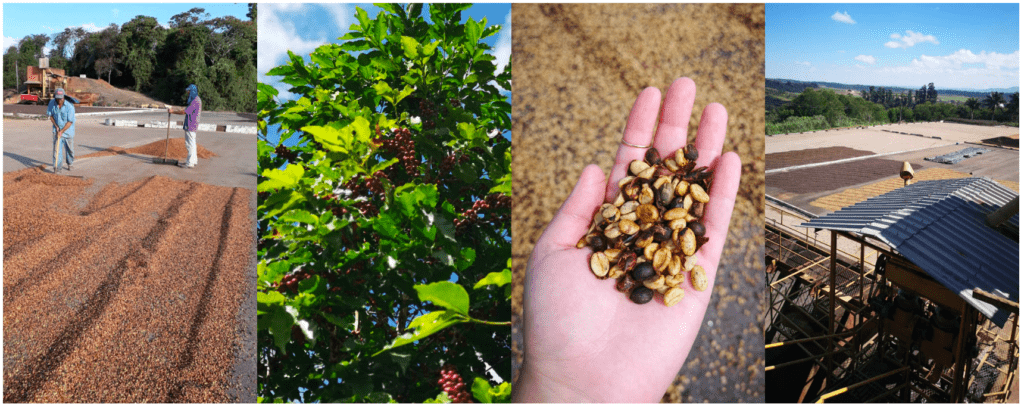
I started to work as an agricultural technician at Fazenda Lagoa in 1982. In 2013 I decided to lease most of its area and dedicate my efforts to produce specialty coffees, as it’s a great place with high altitude and fertile soil, the right place for my goal. After gathering all the experience, I needed, I acquired my own property, 74 hectares in coffee.
I named the place as ‘Sítio Ferradura’. This means “horseshoe” in English, something that, it’s said, can work as a lucky charm bringing good luck and fortune. I believe specialty coffee culture has been such a blessing in my life, it brought me many remarkable moments and it gives me the opportunity to meet amazing people. It’s a pleasure to know my specialty coffees are recognized and valued.
Sorry, the comment form is closed at this time.